


Closing out a sprinkler installation involves several common activities. The acceptance test is completed, the certificate of occupancy or local equivalent is issued, the contractor's crew leaves for the next project, and the drawings, submittals, and certificates are handed over to a facility manager who has a hundred other things to look after. One phase in the building's life cycle ends and another begins. On that day, everyone leaves with the confidence that the system will work if called upon. From that day forward, the owner is responsible for keeping the system serviced. System service consists of inspection, testing, and maintenance, or ITM for short. Inspection is a visual examination to verify that a system appears to be in operating condition and is free of physical damage. Testing is the operation of a device, or the measurement of a system characteristic, to verify that it works and meets its requirements. Maintenance is the work performed to keep equipment operable. The three are separate tasks with separate purposes, but the aim is the same, which is to keep a system capable of doing what it was designed to do (NFPA 25 Sections 3.3.24, 3.3.27, and 3.3.45).
A pump house in Moosburg
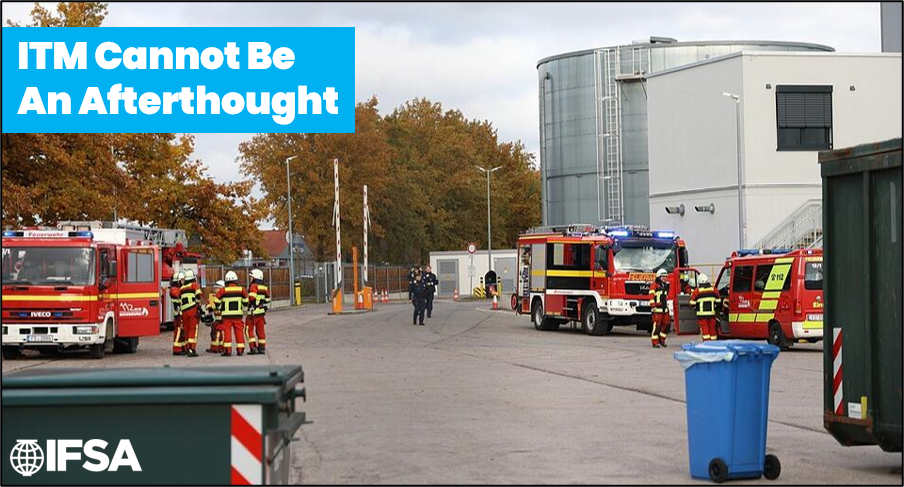
A news report published by idowa.de describes a leak in the diesel fuel line of the fire pump at the Amazon distribution center in Moosburg, Germany. The leaked fuel ignited, and the local fire service had to extinguish the fire. So how does a fuel leak in a pump room go unnoticed?
What the European rules ask for
The basis for servicing the system was likely EN 12845, Fixed firefighting systems, Automatic sprinkler systems, Design, installation and maintenance, together with the VdS CEA 4001 guideline. What makes the event worth studying is that any leak should have been identified as part of the weekly service visit.
EN 12845 requires the weekly routine at intervals of no more than 7 days, and for a diesel engine that means a run of 20 minutes, or the time the supplier recommends, followed by a stop and an immediate manual restart (Clause 20.2.2.5). Oil pressure and engine temperatures are monitored throughout, the oil hoses are checked, and a general inspection is made for leakage of fuel, coolant, or exhaust fumes. CEA 4001 repeats the routine in Clause 18.3.2.5 and sets the run at 20 minutes or the manufacturer's recommended time, whichever is greater. Both documents ask for the exact observation that should have found the leak in the fuel line.
What European regulators can take from NFPA 25
In EN 12845 and CEA 4001, the weekly routine is the user's responsibility, carried out by an individual the owner appoints and the installer instructs, with a substitute named in case that person is absent (EN 12845 Clause 20.1.1 and CEA 4001 Clause 1.4.4). EN 12845 requires the scheduled service to be contracted to the installer or a similarly qualified company, while CEA 4001 requires that contract only where the authorities ask for it. The yearly diesel routine in both European documents is the failed-to-start test, with whatever procedures the supplier adds. The European documents have strengths of their own. Both require an independent annual inspection by a third party, and CEA 4001 has the authorities set the time limits for correcting the faults that inspection finds (Clause 1.4.3.1). CEA 4001 also makes the precautions for a system that is out of service mandatory (Clause 18.1.3), where Annex J of EN 12845 offers them as recommendations.
NFPA 25, the Standard for the Inspection, Testing, and Maintenance of Water-Based Fire Protection Systems, is firmer about who does the work. It requires qualified personnel for the specific tasks performed (Section 4.1.1.3), and for a fire pump it requires qualified personnel to be in attendance whenever the pump is running (Section 8.3.2.7). NFPA 25 also goes further on the diesel fuel system itself. Stored fuel is tested annually for degradation (Section 8.3.4.1), flexible hoses and connections are inspected annually for cracks and leaks (Section 8.1.1.2.11), and the fuel tank and its supervisory signals are tested quarterly (Section 8.1.1.2.7).
What a year of weekly visits looks like
Under NFPA 25, a diesel engine driven fire pump receives the same visit every week. The technician confirms that the room is heated and the louvers move, checks that the fuel tank is at least two-thirds full, and starts the engine, which must run for a minimum of 30 minutes (Section 8.3.2.4). A technician who runs the engine and walks the room will see a fuel leak and note it, and NFPA 25 gives that technician more places to look. The annex, Table A.8.1.1.2, which applies where the manufacturer gives no recommendations, lists the flexible hoses and connectors in the diesel fuel system as a weekly visual inspection. A log with 52 weekly entries and no leak finding looks like proof of a dependable installation. It is proof only if the visits were made, and made by a technician who ran the engine and looked at the fuel connections and at the floor beneath them. Service performed on this schedule is intended to find a leak before it becomes a fire, which makes the question for Moosburg whether the visits were made and what was recorded.
Lessons learned
Four lessons follow from Moosburg, and each applies to any building with a diesel engine driven fire pump.
-
Service is the owner's responsibility. Installation ends at acceptance and the certificate of occupancy, and service begins when the owner occupies the building. From that day the owner is responsible for keeping the system serviced, and a system that is not serviced may not function properly in a fire event.
-
Keep the fuel system in view. Good lighting and clear visual access to the engine and its fuel connections are good practice in any pump room, because a technician cannot report a leak that cannot be seen.
-
Require a qualified person for the weekly visit. A leak is found by a person who knows what one looks like and understands the consequences if something goes wrong. A simple log cannot do that.
-
Assess the risk and notify stakeholders. A fire pump that cannot run safely leaves the sprinkler system impaired, and NFPA 25 lists fire pumps among the equipment covered by its impairment program (Section 15.4.2). An equipment failure found during inspection, testing, or maintenance counts as an emergency impairment (Section 15.6.1), which gives the owner's impairment coordinator work to do at once.
At Moosburg, a leak in the fuel line of the fire pump ignited, and the automatic sprinkler system was not available on the day the building needed it. The local fire service extinguished the fire, and that outcome rested on circumstances the owner did not control, such as how close the fire department was and how soon the fire was found. A sprinkler system is installed so that the result does not depend on those circumstances.
Whether the weekly visits were made at Moosburg is a question for the service records. What the standards leave no doubt about is that the observation which finds a leak before it finds an ignition source is a routine task, and that it belongs to the owner from the day the building is occupied. The impairment was foreseeable and preventable with proper ITM. Installation and system acceptance shows that a system can work. Service determines whether it does.
References
NFPA 25, Standard for the Inspection, Testing, and Maintenance of Water-Based Fire Protection Systems, 2026 edition. Sections 3.3.24, 3.3.27, 3.3.45, 4.1.1.3, 8.1.1.2, 8.2.2, 8.3.2.4, 8.3.2.7, and 8.3.4.1, Chapter 15, and Table A.8.1.1.2.
EN 12845, Fixed firefighting systems, Automatic sprinkler systems, Design, installation and maintenance. Clauses 19 to 21 and Annex J.
CEA 4001, Sprinkler Systems, Planning and Installation, 2017 edition. Clauses 1.4.3, 1.4.4, 18.1, and 18.3.
idowa.de, Feuerwehreinsatz in Amazon-Verteilzentrum in Moosburg.