


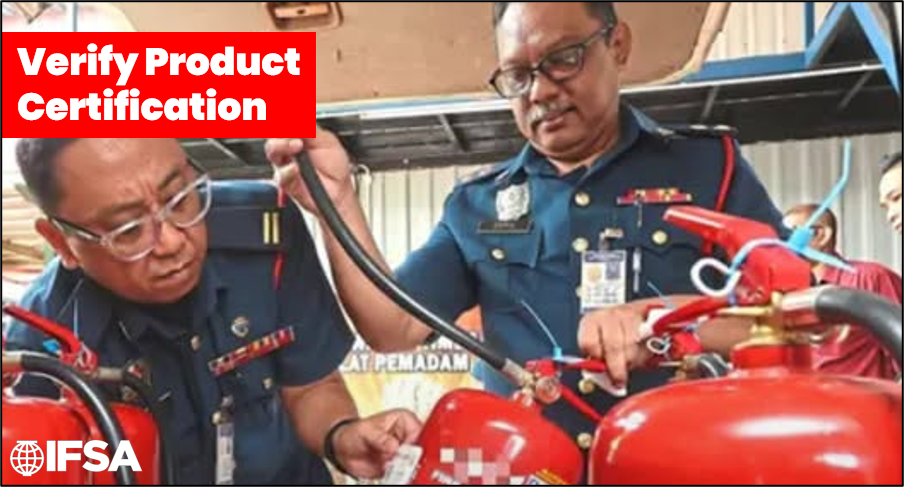
A Vietnamese court case shows that a certificate can be purchased, a label can be printed, and a cylinder can be filled with almost nothing. The failure appears only when someone needs the product to work.
A fire extinguisher hangs on a wall for years. Most of the people who own one never discharge it, and most of the people who inspect one look at the tag, the gauge, and the seal. The owner assumes the contents match the label, because nothing visible suggests otherwise.
One buyer in Vietnam learned otherwise. He purchased 180 Dragon-brand dry powder extinguishers for about 63 million dong (about US$2,400), and when he used them on a fire, some did not put it out. He complained to police on September 17, 2025. Police tests, as reported by VnExpress, found that the extinguishing agent made up between 2 and 6 percent of the contents, against a required 90 percent or more, and Tuoi Tre reports that the powder lacked the monoammonium phosphate and ammonium sulfate printed on the packaging. The arithmetic is short: 90 divided by 6 is 15, and 90 divided by 2 is 45, so the contents held between one-fifteenth and one-forty-fifth of the minimum. The cylinder looked complete. It was not.
The scale of the alleged operation
Prosecutors allege that two companies, Vietlink and An Phu Electrical and Lighting, put more than 1.27 million counterfeit extinguishers on the market, with sales that Tuoi Tre puts above 460 billion dong (about US$17.9 million). Nine defendants face trial, including a Chinese national who supervised production. According to the indictment as reported, Vietlink worked from 2019 with a company in Shandong to import under-dosed powder and assemble the extinguishers in Vietnam, and production moved to An Phu in late 2024. The trial opened in Hanoi on November 11, was postponed because several parties were absent, and resumes on November 30.
These are allegations, and the defendants are entitled to the outcome of the proceeding. The facts reported so far are nonetheless enough to show how the failure occurred.
The paperwork failed at two levels
Police say bribes totaling more than 17 billion dong (about US$660,000) were paid so that the products would be certified as passing. According to Tuoi Tre, a private inspection firm, Phuong Nam, was under contract from June 2023, and its staff allegedly took samples in violation of procedure and recorded false passing results, with bribes calculated per unit. VnExpress adds that a second company issued 302 calibration certificates for equipment it never checked, and that a deputy head at the Vietnam Metrology Institute is charged with forgery in office. The records that were meant to prove the product, and the records that were meant to prove the test equipment, were both false.
This is the detail that deserves the most attention. A buyer who asks for a certificate and receives one has done what procurement guidance asks. The paper was present. The performance was not.
The non-obvious risk is therefore not the counterfeit cylinder alone. It is the false confidence that a counterfeit cylinder with a genuine-looking certificate produces. A building owner with 180 extinguishers on the wall believes the building is protected, and that belief removes the reason to look further. A visible deficiency gets corrected. A hidden one waits.
What a listed extinguisher has that a purchased certificate lacks
The reporting does not describe any third-party listing for the Dragon extinguishers, and the Vietnamese requirements are not described in the sources reviewed for this article. A comparison with the framework used in the United States nonetheless shows what a certificate alone cannot supply.
Section 4.1.1 of the 2026 edition of NFPA 10, the Standard for Portable Fire Extinguishers, requires that extinguishers used to comply with it be listed and labeled. They must meet or exceed all the requirements of UL 711 and CAN/ULC-S508, Rating and Fire Testing of Fire Extinguishers, and one of the applicable performance standards, which differ by agent type. For dry chemical extinguishers, the performance standard is UL 299 and CAN/ULC-S504, Dry Chemical Fire Extinguishers. UL Product iQ names the same two standards as the basic standards for this product category. UL 299 covers construction and performance requirements and leaves the fire tests to UL 711, so a dry chemical extinguisher is evaluated against both.
UL 711 produces the rating through live fire tests. Class A ratings rely on wood crib and wood panel fires, Class B ratings rely on liquid fuel pan fires, and an extinguisher rated 3-A must put out the crib fire without reignition. A rating such as 6A 80B:C printed on a label is therefore a record of fires that a sample of the design actually extinguished. An extinguisher holding a few percent of its required agent cannot reasonably be expected to repeat that result.
A listing also differs in kind from a certificate, because it continues. UL Product iQ describes the UL Mark as the only method of identifying products manufactured under its certification and follow-up service, so the mark points to surveillance of production and not to a single approval. The certification mark carries a file number and the listing mark carries a control number, and either can be searched in the Product iQ directory.
A mark can be forged, and so can a label. In December 2025, UL Solutions warned that certain POLAR 9 kg (20 lb) dry chemical extinguishers, classified 6A 80B:C, carried unauthorized UL Marks and a label citing UL 299 and UL 711, although they had not been evaluated. The label named the correct standards. It proved nothing. The directory entry is the evidence, and the label is only a claim to be checked against it.
NFPA 10 also governs what happens after purchase, and its intervals show where a counterfeit would be found and where it might not. Section 7.2.1.2 calls for inspection at intervals not exceeding 31 days, and the inspection items in Section 7.2.2 include location, access, and the pressure gauge reading. Fullness by weighing or hefting is listed for self-expelling, cartridge-operated, and pump tank types. For a stored-pressure dry chemical extinguisher, the monthly check therefore relies on a gauge that indicates the pressure of the expellant gas and not the quantity of powder, and a cylinder with little agent inside may pass it.
The checks that reach the contents come later. Section 7.3.1.1 calls for maintenance at intervals of not more than one year, and the maintenance procedures in Section 7.3.1 include examination of the extinguishing agent. Section 7.3.6 requires stored-pressure extinguishers that need a 12-year hydrostatic test to be emptied and examined internally every 6 years, and Section 7.8.1.3 requires the amount of recharge agent to be verified by weighing. The monthly check and the periodic examination answer different questions, and only the second reaches the powder.
Why the problem extends beyond one market
The case has reached court as Vietnam intensifies its enforcement against counterfeit goods, following a US threat of additional tariffs over intellectual-property enforcement. Bloomberg reports that a US Section 301 trade investigation into these violations, due to report in November, has been extended until February. Enforcement pressure of this kind is useful, but it begins with trade policy and arrives at fire safety by indirect routes. The buyer who needs a working product receives the benefit last.
The problem is also not confined to one country. UL has issued public notices on extinguishers bearing counterfeit or unauthorized marks that were distributed in Costa Rica, Peru, Panama, and through online sellers, and the US Coast Guard has warned of counterfeit marine extinguishers that copied genuine brands. The supply chain described in the Hanoi case, with substandard components imported in bulk, assembled locally, and sold through distributors with purchased paperwork, is a pattern that any product in the fire protection sector can follow, including the automatic fire sprinklers that IFSA exists to promote. A saving on uncertified components is not a saving at all.
What buyers, installers, and building owners can do
Verify the listing in the directory, not on the label: Search the file number or control number in UL Product iQ, or confirm the model in the FM Approval Guide, the LPCB Red Book, or the VdS directory, rather than relying on a certificate supplied by the seller.
Match the unit to the entry: The manufacturer, model, and classification printed on the extinguisher must agree with the directory entry. Any difference is a reason to stop and ask.
Buy from the manufacturer or its named distributor: A distributor who cannot show a documented supply line to the manufacturer cannot show that the product is genuine.
Use a certified technician and keep the records: NFPA 10 Section 7.1.2.1 requires persons who perform maintenance and recharging to be certified, and the certificate must be made available to the authority having jurisdiction on request. Purchase records, batch numbers, and service tags should be retained so that a later finding can be traced and reported. An extinguisher should never be tested by setting a fire.
A product suspected of bearing a counterfeit UL Mark can be reported through the UL Solutions online concern reporting portal, and UL Solutions opens an investigation once a report is submitted. IFSA does not take reports on portable fire extinguishers, since they are not sprinkler products. Suspected counterfeit sprinkler system products can be reported to IFSA at https://ifsa.global/report-counterfeit.
The test that cannot be forged
A fire extinguisher is tested by a laboratory, listed by a certification body, and sold on the strength of both. Every step can be documented, and every step can be bypassed by someone willing to pay for the paperwork or print the label. A fire cannot be bypassed. It tests the product on the one day that counts, and it accepts no certificate.
Additioanl Reading
Fire Engineering. Construction Concerns: Fire Extinguisher Testing.
UL Solutions Warns of Counterfeit Safety Marks on Fire Extinguishers, December 19, 2025.
UL Standards and Engagement. UL 299, Dry Chemical Fire Extinguishers, Edition 12, December 18, 2024.
UL Solutions. Online concern reporting portal.
VnExpress. Lo duong day 1,27 trieu binh chua chay gia tu mot khach hang (in Vietnamese).